National Gallery of Art to present George Bellows retrospective in 2012
By Jacqueline Trescott, Published: September 29
The first full retrospective of American artist George Bellows in more than three decades will open at the National Gallery of Art next year, the museum announced Thursday.
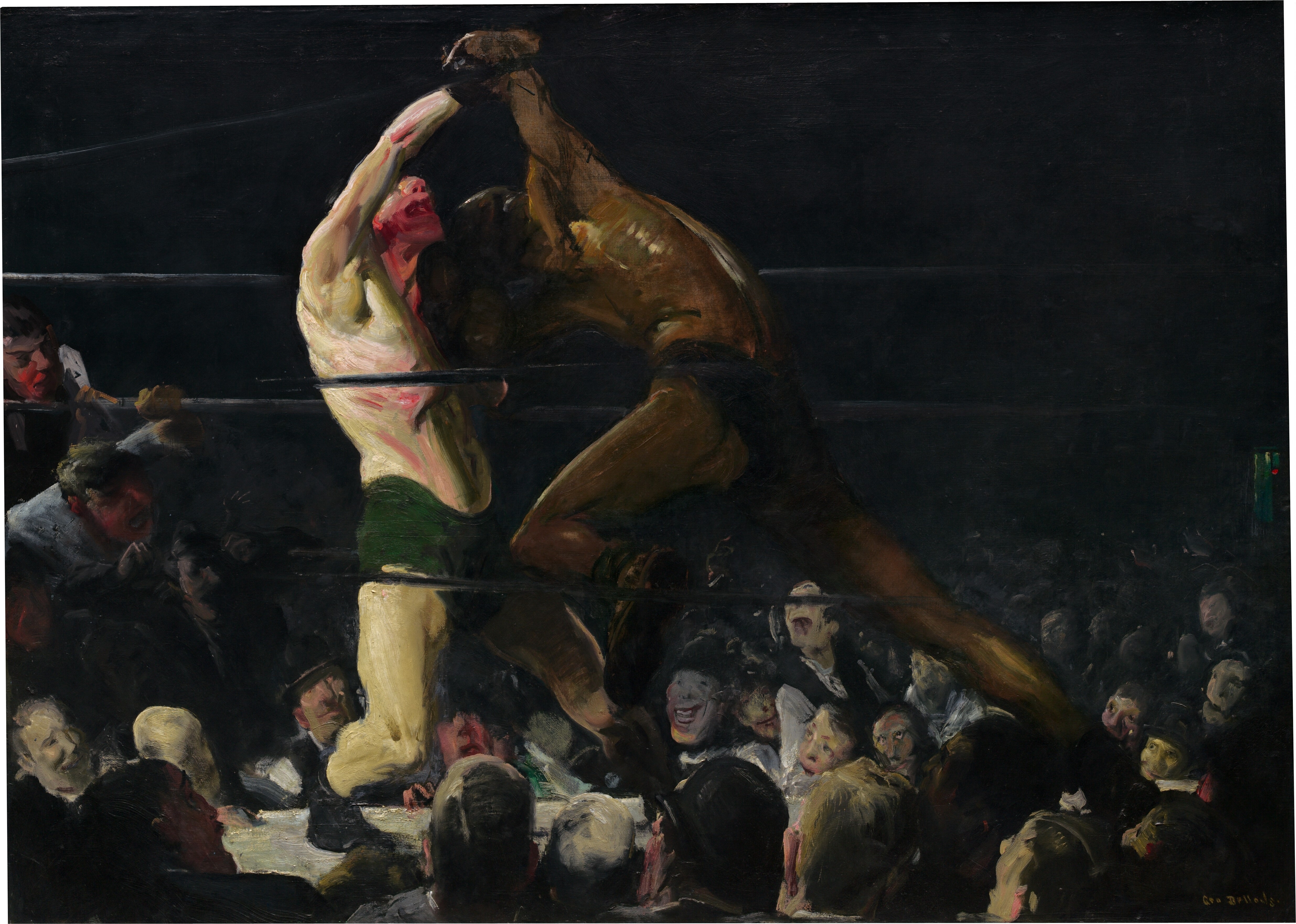
Bellows, one of the famed artists of the Armory Show in 1913, was an important transitional figure between the Victorian and modern eras. Widely known for his dramatic scenes of boxers and urban life, Bellows was interested in everything around him. His work is celebrated for its detailed renderings of dreary life in New York, with laundry hanging out apartment windows and people crowded on tenement steps. But he found a contrast in the lyrical views of snow in the parks, and in formal portraits, mostly of his family.
The exhibit, organized by the gallery, will include about 140 paintings, drawings and lithographs. The last major exhibition of Bellows’s work, concentrated on his paintings, was mounted 20 years ago at the Los Angeles County Museum of Art. Thirty years ago the National Gallery did a show of his boxing paintings, and in 1957 Bellows was the subject of the gallery’s first solo artist exhibition.
“We want to establish a more expansive view of Bellows,” said Charles Brock, associate curator for the gallery’s American and British paintings. “He was a hugely ambitious painter, yet he is known in a very narrow way. This is a survey of his entire career.
“You can misunderstand Bellows if you look at him too narrowly. We want to introduce him to new generations.”
Bellows was a complicated artist and individual, often under-appreciated.
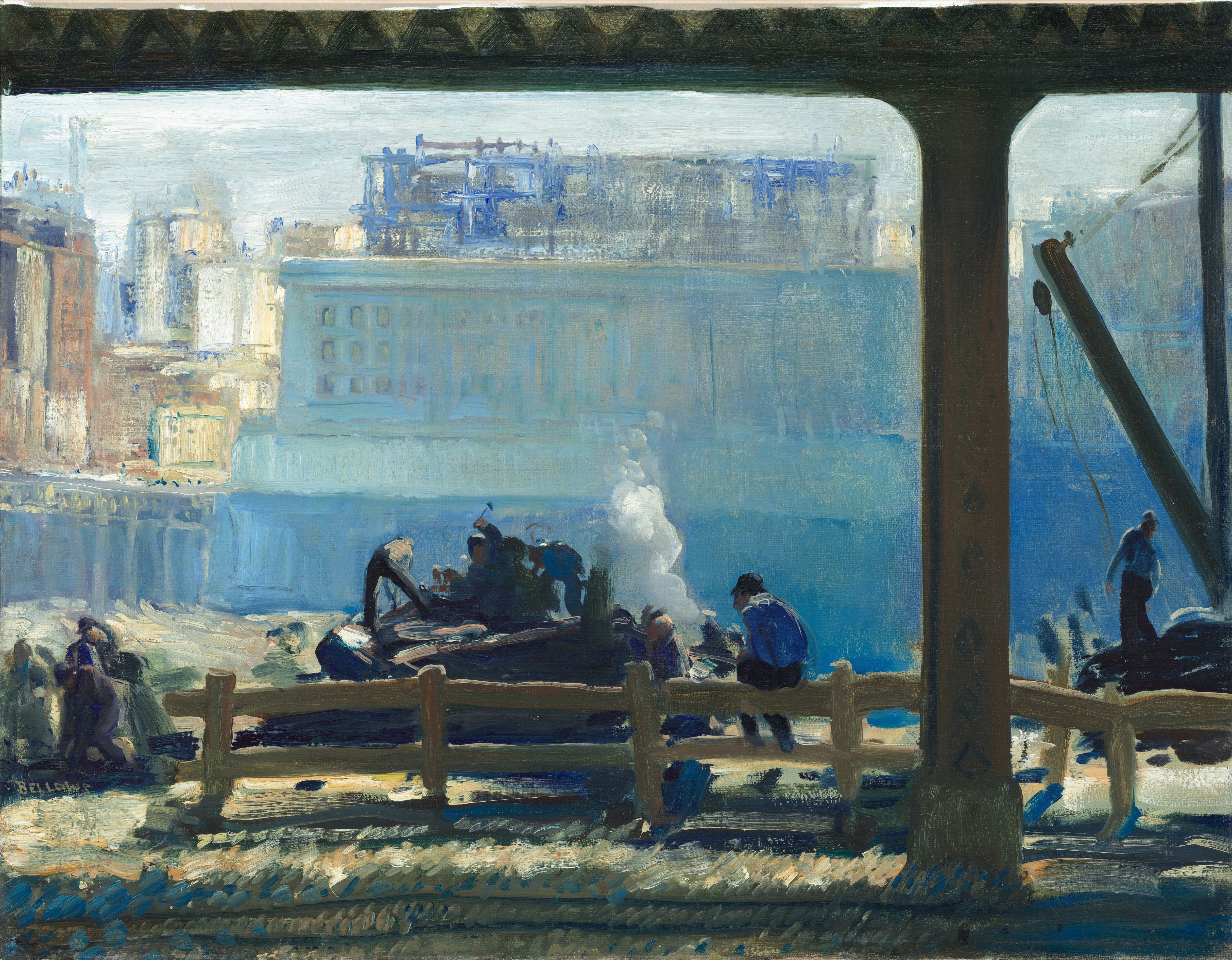
“Look at the way he depicts New York,” Brock said. “In our Chester Dale show, we put Bellows’s ‘Blue Morning’ between two works by Monet. You can see how innovative Bellows was in terms of color and concepts of the city.”
His influence needs to be restated, Brock said.
“This generation navigates the transition to the modern world,” he said. “Bellows essentially keeps alive the figurative representative traditions into the modern era. Edward Hopper is the heir to that.”
After the National Gallery show from June 10 to Oct. 8, “George Bellows (1882-1925)” will travel to the Metropolitan Museum of Art in New York and the Royal Academy of Arts in London.
George Wesley Bellows (August 12 or August 19, 1882 - January 8, 1925) was an American realist painter, known for his bold depictions of urban life in New York City, becoming, according to the Columbus Museum of Art, "the most acclaimed American artist of his generation".
Bellows was born and raised in Columbus, Ohio. He was an only child, born four years after his parents married, at the ages of fifty and forty respectively. His mother, Anna Wilhelmina Smith, was the daughter of a whaling captain.Belows attended The Ohio State University from 1901 until 1904. There he played for the baseball and basketball teams, and provided illustrations for the Makio, the school's student yearbook. He was encouraged to become a professional baseball player, and he worked as a commercial illustrator while a student and he continued to accept magazine assignments throughout his life. Despite these opportunities in athletics and commercial art, Bellows desired success as a painter. He left Ohio State in 1904 just before he was to graduate and moved to New York City to study art.
Bellows was soon a student of Robert Henri at the New York School of Art, and became associated with Henri's "The Eight" and the Ashcan School, a group of artists who advocated painting contemporary American society in all its forms. By 1906, Bellows was renting his own studio, on Broadway.
Bellows first achieved notice in 1908, when he and other pupils of Henri organized an exhibition of mostly urban studies. While many critics considered these to be crudely painted, others found them audacious and a step beyond the work of his teacher. Bellows taught at the Art Students League of New York in 1909, although he was more interested in pursuing a career as a painter. His fame grew as he contributed to other nationally recognized juried shows.
Bellows' urban New York scenes depicted the crudity and chaos of working-class people and neighborhoods, and also satirized the upper classes. From 1907 through 1915, he executed a series of paintings depicting New York City under snowfall. These paintings were the main testing ground in which Bellows developed his strong sense of light and visual texture.] These exhibited a stark contrast between the blue and white expanses of snow and the rough and grimy surfaces of city structures, and created an aesthetically ironic image of the equally rough and grimy men struggling to clear away the nuisance of the pure snow. However, Bellows' series of paintings portraying amateur boxing matches were arguably his signature contribution to art history. These paintings are characterized by dark atmospheres, through which the bright, roughly lain brushstrokes of the human figures vividly strike with a strong sense of motion and direction. Growing prestige as a painter brought changes in his life and work. Though he continued his earlier themes, Bellows also began to receive portrait commissions, as well as social invitations, from New York's wealthy elite. Additionally, he followed Henri's lead and began to summer in Maine, painting seascapes on Monhegan and Matinicus islands.
At the same time, the always socially conscious Bellows also associated with a group of radical artists and activists called "the Lyrical Left", who tended towards anarchism in their extreme advocacy of individual rights. He taught at the first Modern School in New York City (as did his mentor, Henri), and served on the editorial board of the socialist journal, The Masses, to which he contributed many drawings and prints beginning in 1911. However, he was often at odds with the other contributors because of his belief that artistic freedom should trump any ideological editorial policy. Bellows also notably dissented from this circle in his very public support of U.S. intervention in World War I. In 1918, he created a series of lithographs and paintings that graphically depicted the atrocities committed by Germany during its invasion of Belgium. Notable among these was The Germans Arrive, which was based on an actual account and gruesomely illustrated a German soldier restraining a Belgian teen whose hands had just been severed. However, his work was also highly critical of the domestic censorship and persecution of anti-war dissenters conducted by the U.S. government under the Espionage Act.
He was also criticized for some of the liberties he took in capturing scenes of war. The artist Joseph Pennell argued that because Bellows had not witnessed the events he painted firsthand, he had no right to paint them. Bellows responded that he had not been aware that Leonardo da Vinci had "had a ticket to paint the Last Supper".
As Bellows' later oils focused more on domestic life, with his wife and daughters as beloved subjects, the paintings also displayed an increasingly programmatic and theoretical approach to color and design, a marked departure from the fluid muscularity of the early work.
In addition to painting, Bellows made significant contributions to lithography, helping to expand the use of the medium as a fine art in the U.S. He installed a lithography press in his studio in 1916, and between 1921 and 1924 he collaborated with master printer Bolton Brown on more than a hundred images. Bellows also illustrated numerous books in his later career, including several by H.G. Wells.
Bellows taught at the Art Institute of Chicago in 1919. In 1920, he began to spend nearly half of each year in Woodstock, New York, where he built a home for his family.] He died on January 8, 1925 in New York City, of peritonitis, after failing to tend to a ruptured appendix.] He was survived by his wife, Emma, and two daughters, Anne and Jean.
Paintings and prints by George Bellows are in the collections of many major American art museums, including the National Gallery of Art in Washington, DC, the Memorial Art Gallery of the University of Rochester, Rochester, New York, and the Whitney and the Museum of Modern Art in New York, and The Hyde Collection, in Glens Falls, NY. The Columbus Museum of Art in Bellows' hometown also has a sizeable collection of both his portraits and New York street scenes.
The Archives and Special Collections at Amherst College holds his papers.
In December 1999, Polo Crowd, a 1910 painting, sold for U.S. $27.5 million to billionaire Bill Gates. In November 2008, Bellows's Men of the Docks a 1912 painting of the Brooklyn docks spanning the East River and depicting the Manhattan skyline in the background, was to be auctioned at Christie's in New York. It was expected to set the record for an American painting sold at auction with an estimate of $25–35 million. The painting's sale however was a source of controversy at Randolph College because it was the first masterpiece purchased for the Maier Museum of Art by students and locals who scraped together $2,500 to purchase it in 1920. Due to a series of lawsuits and the deflated art market; the painting remains unsold and in limbo.
Natalia Sergeevna Goncharova

Natalia Sergeevna Goncharova (June 16, 1881 - October 17, 1962) was a Russian avant-garde artist (Cubo-Futurism), painter, costume designer, writer, illustrator, and set designer. Her great-aunt was Natalia Pushkina, wife of the poet Alexander Pushkin.
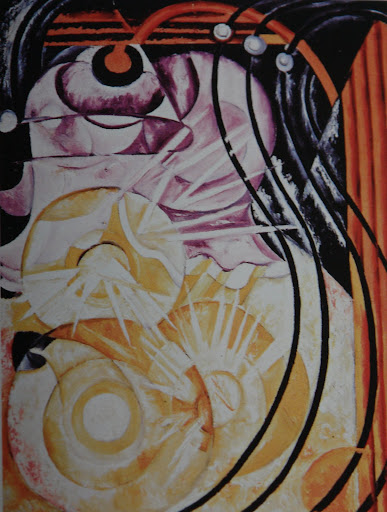
Goncharova was born in Nagaevo village near Tula, Russia in 1881. She studied sculpture at the Moscow Academy of Art, but turned to painting in 1904. She was deeply inspired by the primitive aspects of Russian folk art and attempted to emulate it in her own work while incorporating elements of fauvism and cubism. Together with her husband Mikhail Larionov she first developed Rayonism. They were the main progenitors of the pre-Revolution Russian avant-garde organising the Donkey's Tail exhibition of 1912 and showing with the Der Blaue Reiter in Munich the same year. The Donkey's Tail was conceived as an intentional break from European art influence and the establishment of an independent Russian school of modern art. However, the influence of Russian Futurism is much in evidence in Goncharova's later paintings. Initially preoccupied with icon painting and the primitivism of ethnic Russian folk-art, Goncharova became famous in Russia for her Futurist work such as The Cyclist and her later Rayonist works. As leaders of the Moscow Futurists, they organised provocative lecture evenings in the same vein as their Italian counterparts. Goncharova was also involved with graphic design - writing and illustrating a book in Futurist style.
Goncharova was a member of the Der Blaue Reiter avant-garde group from its founding in 1911. In 1915, she began to design ballet costumes and sets in Geneva. Her designs for the ballet Liturgy: Six Winged Seraph,Angel, St. Andrew, St. Mark, Nativity etc. were started in 1915. The Liturgy was commissioned by Diaghilev with Goncharova, Léonide Massine and Igor Stravinsky. She moved to Paris in 1921 where she designed a number of stage sets of Sergei Diaghilev's Ballets Russes. She also shows at the Salon d'Automne in 1921, and participates regularly at the Salon des Tuileries and the Salon des Indépendants. She became a French citizen in 1939. Goncharova died in Paris, in 1962.
On June 18, 2007 Goncharova's 1909 painting Picking Apples was auctioned at Christie's for $9.8 million, setting a record for any female artist. In November 2007, Bluebells, (1909), brought $6.2 million. The record was updated a year later, when Goncharova's 1912 still-life The Flowers (formerly part of Guillaume Apollinaire's collection) sold for $10.8 million
MoMA Offers Online Courses in Modern Art History and Studio Art
--Art Lovers Can Explore the Exciting World of Modern Art, Anytime and Anywhere --Registration Now Open for Fall 2011 Instructor-Led and Self-Guided Courses
NEW YORK, Sept. 23, 2011 /PRNewswire via COMTEX/ -- This fall, The Museum of Modern Art's online courses allow newcomers and experienced art lovers from around the world to learn about modern art through MoMA's world-renowned collection, from any location at times convenient for them. These 10-week courses invite students to discover the fascinating stories and ideas behind some of the masterpieces in MoMA's collection through a rich variety of multimedia materials, including text, images, narrated slideshows, and engaging videos shot on location in the Museum's galleries.
To view the multimedia assets associated with this release, please click http://www.prnewswire.com/news-releases/moma-offers-online-courses-in-modern-art-history-and-studio-art-130384903.html
MoMA offers online courses in two formats:
For 10 weeks (starting October 3), MoMA Instructor-led courses offer unlimited access to videos, slideshows, audio, multimedia resources, and readings, plus discussion forums that allow the instructor and students to interact.
Price: $350; $300 for educators, students, seniors, other museum staff, and members.
Self-Guided (available now) courses are a go-at-your-own-pace option that offer the same content as MoMA instructor-led courses, without the discussion forums and instructor guidance.
Price: 10-week access: $200; $175 for educators, students, seniors, other museum staff, and members.
There are two online courses to choose from:
Modern Art, 1880-1945 uses works from MoMA's collection to introduce students to the key artworks and iconic figures of modern art including such renowned artists as Paul Cezanne, Vincent van Gogh, Marcel Duchamp, Henri Matisse, and Pablo Picasso, among others.
Materials and Techniques of Postwar Painting is a focused look at postwar abstract painting from an artist's point of view -- this course goes into the studio to reveal the materials and techniques that created some of the 20th century's greatest masterpieces. Guided by an artist and former MoMA conservator, this studio course covers the art history of the period and offers step-by-step video instruction on the materials and techniques used by iconic painters from Jackson Pollock to Barnett Newman.
Registration now open at MoMA.org/coursesonline
Online Courses are made possible by a partnership with Volkswagen of America.
Related links:
The Museum of Modern Art
--Art Lovers Can Explore the Exciting World of Modern Art, Anytime and Anywhere --Registration Now Open for Fall 2011 Instructor-Led and Self-Guided Courses
NEW YORK, Sept. 23, 2011 /PRNewswire via COMTEX/ -- This fall, The Museum of Modern Art's online courses allow newcomers and experienced art lovers from around the world to learn about modern art through MoMA's world-renowned collection, from any location at times convenient for them. These 10-week courses invite students to discover the fascinating stories and ideas behind some of the masterpieces in MoMA's collection through a rich variety of multimedia materials, including text, images, narrated slideshows, and engaging videos shot on location in the Museum's galleries.
To view the multimedia assets associated with this release, please click http://www.prnewswire.com/news-releases/moma-offers-online-courses-in-modern-art-history-and-studio-art-130384903.html
MoMA offers online courses in two formats:
For 10 weeks (starting October 3), MoMA Instructor-led courses offer unlimited access to videos, slideshows, audio, multimedia resources, and readings, plus discussion forums that allow the instructor and students to interact.
Price: $350; $300 for educators, students, seniors, other museum staff, and members.
Self-Guided (available now) courses are a go-at-your-own-pace option that offer the same content as MoMA instructor-led courses, without the discussion forums and instructor guidance.
Price: 10-week access: $200; $175 for educators, students, seniors, other museum staff, and members.
There are two online courses to choose from:
Modern Art, 1880-1945 uses works from MoMA's collection to introduce students to the key artworks and iconic figures of modern art including such renowned artists as Paul Cezanne, Vincent van Gogh, Marcel Duchamp, Henri Matisse, and Pablo Picasso, among others.
Materials and Techniques of Postwar Painting is a focused look at postwar abstract painting from an artist's point of view -- this course goes into the studio to reveal the materials and techniques that created some of the 20th century's greatest masterpieces. Guided by an artist and former MoMA conservator, this studio course covers the art history of the period and offers step-by-step video instruction on the materials and techniques used by iconic painters from Jackson Pollock to Barnett Newman.
Registration now open at MoMA.org/coursesonline
Online Courses are made possible by a partnership with Volkswagen of America.
Related links:
The Museum of Modern Art
Civil rights-era, Oswald photographer dies at 82
By RUSSELL CONTRERAS
Associated Press
Published: Friday, Sep. 23, 2011 - 7:50 am
ALBUQUERQUE, N.M. -- Shel Hershorn, a photojournalist who captured iconic images of the civil rights movement and of a fatally wounded Lee Harvey Oswald, has died at age 82.
Hershorn died Sept. 17 of pneumonia at a northern New Mexico nursing home, his wife, Sonja Hershorn, said Friday.
Born in Denver as Herbert Sheldon Hershorn, he learned aerial photography while serving in the U.S. Navy and began his career as a photographer at a Casper, Wyo. newspaper. He moved to Dallas in 1954 to work for the Dallas Times Herald and United Press International. He later captured images of the Freedom Riders and Alabama Gov. George Wallace attempting to block black students from enrolling at the University of Alabama.
Sonja Hershorn, of Gallina, N.M., said his charming personality allowed him to muscle into tough spots to get the shots he needed. "He could charm a Texas sheriff out of his gun," she said.
During the 1960 presidential campaign, Hershorn followed then-Sen. John F. Kennedy and Senator Majority Leader Lyndon Johnson around Texas. He would photograph President Kennedy in 1963 speaking to a Dallas crowd before his assassination and days later, photographed Lee Harvey Oswald just as he was being loaded into an ambulance after he was shot by Jack Ruby.
The assassination of Kennedy began to turn him away from photojournalism. "After the Kennedy assassination he just lost all hope," said Sonja Hershorn.
In the immediate years following the assassination, Hershorn worked as a freelance photographer for publications including Life, Fortune, Newsweek, Esquire and Sports Illustrated. He helped with coverage of Charles Whitman's shootings on the University of Texas campus including the 1966 Life Magazine cover shot of UT tower viewed through bullet-shattered glass.
He would also shoot lasting images of the opening of the Houston Astrodome in 1965 and later New Mexico-based artist Georgia O'Keeffe.
Hershorn eventually donated his archives to the Dolph Briscoe Center for American History at the University of Texas at Austin.
In 1970, Hershorn moved outside of Taos, N.M. with the goal of "throwing it all away" as a hippie and living without many of the conveniences of modern life. He worked for a time in a plumbing and eventually became a furniture maker, his wife said.
He also taught photography on the side to actor Dennis Hopper among others, and often shared stories about his photojournalism past.
"I was charmed out, too," said Sonja, who met Hershorn in New Mexico while she was a teacher. "He'd talked about meeting Martin Luther King, Jr., and getting arrested with (comedian) Dick Gregory...what are you going to do? I didn't stand a chance."
Shel Hershorn is survived by his wife and two sons from a previous marriage, James "Tad" Hershorn of New Brunswick, N.J., and Pat Hershorn of Dallas.
Suprematism
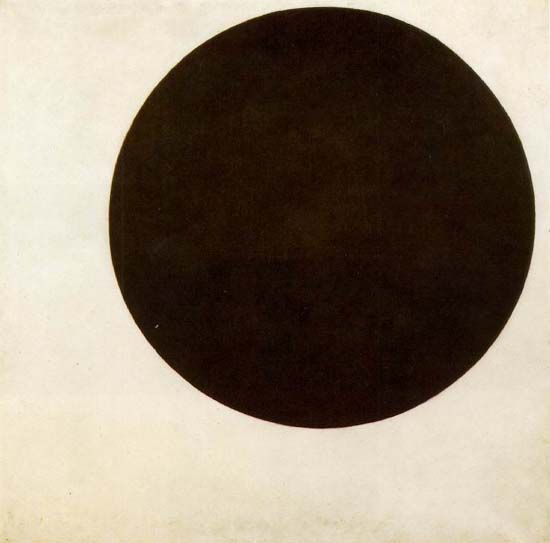
Suprematism was an art movement focused on fundamental geometric forms (in particular the square and circle) which formed in Russia in 1915-1916. It was founded by Kasimir Malevich who originated Suprematism in 1915 when he was an established painter having exhibited in the Donkey's Tail and the Der Blaue Reiter (The Blue Rider) exhibitions of 1912 with cubo-futurist works. The proliferation of new artistic forms in painting, poetry and theatre as well as a revival of interest in the traditional folk art of Russia provided a rich environment in which a Modernist culture was born.
In his book The Non-Objective World, which was published abroad as a Bauhaus Book in 1927, Malevich described the inspiration which brought about the powerful image of the black square on a white ground: “I felt only night within me and it was then that I conceived the new art, which I called Suprematism.”
He created a suprematist 'grammar' based on fundamental geometric forms; in particular, the square and the circle. Malevich also credited the birth of suprematism to Victory Over the Sun, Kruchenykh's Futurist opera production for which he designed the sets and costumes in 1913. One of the drawings for the backcloth shows a black square divided diagonally into a black and a white triangle. Because of the simplicity of these basic forms they were able to signify a new beginning.
Another important influence on Malevich were the ideas of the Russian mystic-mathematician, philosopher, and disciple of Georges Gurdjieff; P. D. Ouspensky who wrote of "a fourth dimension or a Fourth Way beyond the three to which our ordinary senses have access".
Subscribe to:
Posts (Atom)