

Showing posts with label bloglapedia. Show all posts
Showing posts with label bloglapedia. Show all posts
New wealth taking art market to new heights
A growing class of super rich
collectors — many from Asia, Latin America and the Middle East — is putting
money into fine art both to gain status and to invest in something new.
By Alana Semuels
December 8, 2013, 5:00 a.m.
NEW YORK — The painting once
hung in the Cleveland Museum of Art. And there was no shortage of people who
wanted it in the crowded Christie's auction room.
The artwork, "Women
Reaching for the Moon," is a blur of a woman in a red dress. It was
painted by
Rufino Tamayo, the famed
Mexican creator of abstract works that combine European and Latino influ-
ences. Though bidding started
at $500,000, it quickly reached $1 million. The standing-room-only crowd
murmured as auctioneer Adrian Meyer parried with the remaining bidders, and
workers wheeled in rows of extra chairs.
"Look at the painting, at
least face it. You still have a chance," Meyer said to a woman in the
audience who had been bidding, as the price went up to $1.2 million. "For
$50,000, it could be yours."
When Meyer finally knocked his
hammer against the lectern, signaling that the painting had sold for $1.2
million, "Women Reaching for the Moon" became the most expensive work
to pass through Christie's for the evening. The auction, held two weeks ago,
was part of Christie's biannual sale of Latin American art.
But it was not the most
expensive to be sold at the auction house this season.
In October, Christie's sold a
triptych by renowned British figurative painter Francis Bacon for $142.4
million, a record price for a painting at auction. The auction house also set a
record for the most expensive work by a living artist when it sold a steel
sculpture, "Balloon Dog" by American contemporary artist Jeff Koons,
for $58.4 million.
Economists may still be worried
about consumer spending as the holiday season approaches, but if the art market
is any indication, the world's wealthiest have lots of money to spend.
As small groups of people get
richer in various countries across the world, observers say, they're putting
money into art both to gain status and invest in something new. Many have never
put their money into art before.
"What we're seeing is that
wealth is expanding in Latin America and the Middle East," said Phillip
Hoffman, head of the Fine Art Fund Group, which consults with wealthy clients
who want to buy art. "The new rich like to enjoy art, show it off, have it
as an alternative asset."
Hoffman's company is 30 times
bigger than it was three years ago, he said, as more wealthy clients become
interested in owning art. He has 120 clients — most from Asia, Europe and Latin
America — who have never owned art before. In fact, one of them dropped $67
million on two paintings.
About 3% of the world's wealthy
now own art, but Hoffman estimates that figure will grow to 30% to 40% in the
next decade.
Art as an investment really
didn't come into vogue until the British Rail Pension Fund, which had begun
acquiring art in the 1970s, began to divest of its artworks, said Barbara
Guggenheim, of the art consultancy Guggenheim Asher Associates. The sales,
which mostly occurred in the 1980s and 1990s, netted tens of millions of
dollars for the fund, leading to an 11% return.
"For the very first time,
Wall Street had something very concrete to look at as a model," she said.
"And Wall Street loves graphs."
The global art market is now
worth about $60 billion.
These days, though, it's not
just art. Wary of losing wealth in the shaky stock market, the super wealthy
are also putting money into alternative investments, such as classic cars,
wine, gems and watches. Sotheby's sold a giant flawless pink diamond for $83
million in Geneva last month, the highest ever paid for a gemstone at auction.
But as sales of other luxuries
including high-end condos boom, art can go hand in hand, said Martin
Friedrichs, assistant director of the Hollis Taggart galleries on New York's
Upper East Side.
"There's a boom of
high-end condos here, and people need something to put on their walls," he
said. "It's much nicer to hang a piece of art than a printout from your
online brokerage account."
These kinds of high-end
investments have been surging as the number of millionaires around the world
has increased dramatically in recent years.
According to Wealth Insight, a
British firm that tracks global wealth, the number of millionaires in China
grew 90% between 2007 and 2012. The number of billionaires in that country grew
400% from 2008 to 2012. And the number of high-net-worth individuals in the
Asia-Pacific region grew 29% between 2007 and 2011.
Chinese buyers bid heavily for
modern art: Picassos, for example. But Hoffman said they've also begun to
invest in Chinese antiquities.
Growing wealth among the rich
in Mexico has led to more competition for Mexican and other Latin American art,
as collectors with more money begin to buy works by artists from multiple
countries.
In Mexico, the number of
millionaires grew 32% between 2007 and 2012, according to WealthInsight. There
were 145,000 millionaires in that country by the end of 2012, holding $736
billion.
"We've seen in the past
five to seven years clients who did not exist before who are buying quite
heavily," said Gabriela Lobo, director of Christie's Mexico.
That's driven up the price of
some Latin American artists who barely sold at all a decade ago. At the Latin
American art auction, a painting by Austrian-Mexican artist Wolfgang Paalen
sold for $200,000; pre-auction estimates had valued the painting at $40,000 to
$60,000.
"Some of these things, we
couldn't give them away, or we'd sell them for nothing," Lobo said.
"Now there's a bigger market for these names."
Diego Uribe flew to New York
from Miami for the Christie's auction with his wife and bid on a work by Carlos
Cruz-Diez. They were outbid. Two out of three of the works for sale by the
Venezuelan artist sold for tens of thousands more than Christie's top
estimates.
"You have to have a
budget," Uribe said.
Still, he wishes he'd been able
to walk away with something.
"It will get more
valuable," he said.
It's still not clear whether
art is actually a smart investment, especially since the market is considered
opaque because many deals are done in private. This puts even more value on the
public auctions to gauge how art might be appreciating or depreciating.
"There are periods where
art outperforms equities and periods where it underperforms, but the important
thing is that it has a low correlation with equities," he said.
From 1987 to 2012, the Mei
Moses World All Art index showed an average annual return of 5%, while the
Standard & Poor's 500 index added 9.6%. Over 60 years, the art index showed
average annual returns of 9.5%, while the S&P was up 10.3%.
But for many super rich with
extra money on hand, it doesn't matter whether the artwork becomes more
valuable or less. They like to look at it on their walls, regardless of what it
costs.
"We don't buy to sell, but
we know it is going to be an asset," Uribe said. "But if it loses
value, I don't care."
alana.semuels@latimes.com
http://www.latimes.com/business/la-fi-art-market-20131208-
Available on amazon


The age of innocence, Reynolds

The Age of Innocence is an oil on canvas picture by Sir Joshua Reynolds, painted in either 1785 or 1788. The sitter is unknown, but was possibly Reynolds's great-niece Theophila Gwatkin (who was three in 1785), or Lady Anne Spencer (1773-1865), the youngest daughter of the 4th Duke of Marlborough.
The picture is a character study, or, in 18th-century terms, a fancy picture, and was painted over another Reynolds work, A Strawberry Girl, perhaps because Strawberry had suffered some paint losses. Only the hands remain in their original state.

Reynolds
The Last of England by Ford Madox Brown

The Last of England is an 1855 oil-on-panel painting by Ford Madox Brown depicting two emigrants leaving England to start a new life abroad.
Brown began the painting in 1852 inspired by the departure of his close friend, the Pre-Raphaelite sculptor, Thomas Woolner, who had left for Australia in July of that year. Emigration from England was at a peak, with over 350,000 people leaving that year. Brown, who at the time considered himself "very hard up and a little mad", was himself thinking of moving to India with his new family.
Although Ford Madox Brown was never a member of the Pre-Raphaelite Brotherhood, The Last of England, like many of his paintings, exhibits all the characteristics of the movement. The painting depicts a man and his wife seeing England for the last time. The two main figures, based on Brown and his wife, Emma, stare ahead, stony-faced, ignoring the white cliffs of Dover which can be seen disappearing behind in the top right of the picture. The clothing indicates that family are middle class, so are not leaving for the reasons that would force the emigration of the working classes; Brown's writing touched on the same theme:
The educated are bound to their country by quite other ties than the illiterate man, whose chief consideration is food and physical comfort
The fair-haired child in the background behind the man's shoulder is Brown and Emma's child, Catherine, who was born in 1850. The hand of the baby, which can be seen clasped by the woman, is supposedly that of their second child, Oliver.
In order to mirror the harsh conditions in the painting Brown worked mostly outside in his garden, and was happy when the weather was poor — he recorded his feelings of delight when the cold turned his hand blue, as this was how he wanted it to appear in the painting. He was seen as strange by his neighbours who saw him out in all kinds of weather. He composed a short verse to accompany the painting in which the woman is depicted as hopeful for the future:
...She grips his listless hand and clasps her child,
Through rainbow tears she sees a sunnier gleam,
She cannot see a void where he will be.
Brown's painting room was above a china shop at 33 High Street, Hampstead and sittings took place in the house's garden. His diary noted that the '...ribbons of the bonnet took me 4 weeks to paint'. The picture was voted Britain's eighth-favorite picture in a poll carried out by BBC Radio

Brown (Above) and his known piece "Work"

Dante and beatrice by Henry Holiday
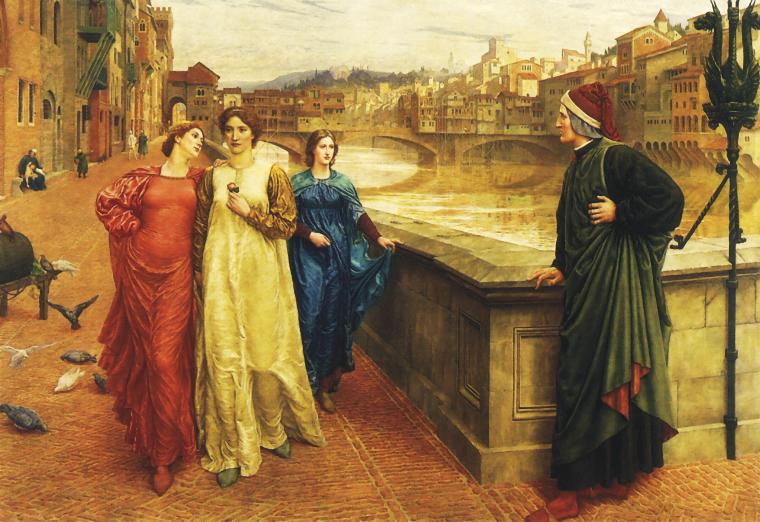
Henry Holiday (17 June 1839 – 15 April 1927) was an English historical genre and landscape painter, stained glass designer, illustrator and sculptor. He is considered to be a member of the Pre-Raphaelite school of art. Holiday also did some sculpture, in 1861 producing a piece called "Sleep" which attracted favourable critical interest.
In 1867, Holiday visited Italy for the first time and was inspired by the originality of the Renaissance artists he saw on display there. In 1871 he went to Ceylon as part of the " Eclipse Expedition". His astronomical drawings were subsequently published in the national press and attracted great interest.
In January 1874, Holiday was commissioned by Lewis Carroll to illustrate The Hunting of the Snark. He remained friends with the author throughout his life. Holiday had been a socialist throughout his life and, together with his wife Kate and daughter Winifred, supported the Suffragette movement. The family were close acquaintances of Emmeline Pankhurst and her daughter, and had organised local suffragette meetings in the Lake District.
Holiday died on 15 April 1927. Dante and Beatrice is a painting dated 1884 and is on display in the Walker Art Gallery in Liverpool, England. It is considered to be Holiday's most important painting. It is executed in oil on canvas, measuring 142.2 centimetres (56 in) by 203.2 centimetres (80 in) and was purchased by the gallery in 1884.
When he died, Holiday was described as "the last Pre-Raphaelite". Many of Dante Gabriel Rossetti's paintings, including Dante's Dream, had as their subject the Italian poet Dante Alighieri, and this interest is the likely inspiration for Holiday's painting.
It is based on Dante's autobiographical work La Vita Nuova which describes his love for Beatrice Portinari. Dante concealed his love by pretending to be attracted to other women. The painting depicts an incident when Beatrice, having heard gossip relating to this, refuses to speak to him. The event is shown as Beatrice and two other women walk past the Santa Trinità Bridge in Florence. Beatrice wears a white dress and walks beside her friend Monna Vanna, with Beatrice's maidservant slightly behind.
In 1860 Holiday had painted another scene from La Vita Nuova which showed a meeting between Dante and Beatrice when they were children in the garden of Beatrice's father, and in 1875 he painted a portrait of Dante. In addition to the completed painting of Dante and Beatrice, the Walker Art Gallery owns three sketches he made for it. Two of these depict all the figures, while the third is of Dante alone. Holiday had also made nude plaster statuettes of the two main female figures to which he later added clothing. These are also owned by the gallery. The model for Beatrice was Eleanor Butcher, Milly Hughes modelled for Monna Vanna, and the model for the maidservant was Kitty Lushington.
Holliday was anxious that the painting should be historically accurate and in 1881 travelled to Florence to carry out research. He discovered that in the 13th century the Lungarno, the street on the north side of the River Arno between the Ponte Vecchio (seen in the background) and the Ponte Santa Trinita, was paved with bricks and that there were shops in the area; these are shown in the painting. He also learnt that the Ponte Vecchio had been destroyed in a flood in 1235. It was being rebuilt between 1285 and 1290 and in the painting it is shown covered in scaffolding.
Crossing the Brook by William (Mallord William) Turner

This painting is the culmination of Turner’s studies of Devon, which he visited in 1811 and 1813. His watercolours and drawings of the area were remarkably fresh and informal. Here, however, he creates a more monumental and self-consciously artful image in the mould of the seventeenth-century classical landscape painter, Claude Lorrain. Even so, contemporaries recognized that the scene was intended to show a particular place: the Tamar valley. This painting was exhibited in the year of the battle of Waterloo. It would have been hard to avoid the patriotic subtext of such a grandly ambitious depiction of the national landscape
Joseph Mallord William "J. M. W." Turner, RA
(baptised 14 May 1775[a] – 19 December 1851) was a British Romantic landscape
painter, water-colourist, and printmaker. Turner was considered a controversial
figure in his day, but is now regarded as the artist who elevated landscape
painting to an eminence rivalling history painting.
Although renowned for
his oil paintings, Turner is also one of the greatest masters of British
watercolour landscape painting. He is commonly known as "the painter of
light" and his work is regarded as a Romantic preface to Impressionism.

Joseph Mallord William Turner (above) was baptised on 14 May 1775,
but his date of birth is unknown. It is generally believed he was born between
late April and early May. Turner himself claimed he was born on 23 April, but
there is no proof of this.[a] He was born in Maiden Lane, Covent Garden,
London, England.
His father, William Turner (1745–21 September 1829), was a
barber and wig maker, His mother, Mary Marshall, came from a family of
butchers. A younger sister, Mary Ann, was born in September 1778 but died aged
four in August 1783.
Drawing of St John's
Church, Margate by Turner from around 1786, when he would have been 11 or 12
years old. The ambitious but unsure drawing shows an early struggle with
perspective, which can be contrasted with his later work
A View of the Archbishop's Palace, Lambeth – this
watercolour was Turner's first to be accepted for the Royal Academy's annual
exhibition in April 1790, the month he turned fifteen. The image is a technical
presentation of Turner's strong grasp of the elements of perspective with
several buildings at sharp angles to each other, demonstrating Turner's
thorough mastery of Thomas Malton's topographical style.
In 1785, as a result of a "fit of illness" in the
family the young Turner was sent to stay with his maternal uncle, Joseph
Mallord William Marshall, in Brentford, then a small town on the banks of the
River Thames west of London. From this period, the earliest known artistic
exercise by Turner is found, a series of simple colourings of engraved plates
from Henry Boswell's Picturesque View of the Antiquities of England and Wales.
Around 1786, Turner
was sent to Margate on the north-east Kent coast. Here he produced a series of
drawings of the town and surrounding area foreshadowing his later work. Turner
returned to Margate many times in later life.
By this time,
Turner's drawings were being exhibited in his father's shop window and sold for
a few shillings. His father boasted to the artist Thomas Stothard that:
"My son, sir, is going to be a painter". In 1789 Turner again stayed
with his uncle, who had retired to Sunningwell in Oxford. A whole sketchbook of
work from this time in Oxford survives, as well as a watercolour of Oxford. The
use of pencil sketches on location as a basis for later finished paintings
formed the basis of Turner's essential working style for his whole career.
Many early sketches
by Turner were architectural studies and/or exercises in perspective and it is
known that as a young man he worked for several architects including Thomas
Hardwick (junior), James Wyatt and Joseph Bonomi the Elder.
By the end of 1789 he
had also begun to study under the topographical draughtsman Thomas Malton, whom
Turner would later call "My real master". He entered the Royal
Academy of Art schools in 1789, when he was 14 years old, and was accepted into
the academy a year later. Sir Joshua Reynolds, president of the Royal Academy,
chaired the panel that admitted him. At first Turner showed a keen interest in
architecture but was advised to continue painting by the architect Thomas
Hardwick. His first watercolour painting A View of the Archbishop's Palace,
Lambeth was accepted for the Royal Academy summer exhibition of 1790 when
Turner was 15.
As a probationer in
the academy, he was taught drawing from plaster casts of antique sculptures and
his name appears in the registry of the academy over a hundred times from July
1790 to October 1793. In June 1792 he was admitted to the life class to learn
to draw the human body from nude models.
Turner exhibited
watercolours each year at the academy – travelling in the summer and painting
in the winter. He travelled widely throughout Britain, particularly to Wales,
and produced a wide range of sketches for working up into studies and
watercolours. These particularly focused on architectural work, which utilised
his skills as a draughtsman.
In 1793, he showed a
watercolour titled The Rising Squall – Hot Wells from St Vincent's Rock Bristol
(now lost) that foreshadowed his later climatic effects.
Cunningham in his
obituary of Turner wrote that it was: "recognised by the wiser few as a
nobel attempt at lift in landscape art out of the tame insipidities...[and]
evinced for the fist time that mastery of effect for which he is now justly
celebrated."
Turner exhibited his
first oil painting at the academy in 1796, Fishermen at Sea: a nocturnal
moonlit scene off The Needles, Isle of Wight. The image of boats in peril
contrasts the cold light of the moon with the firelight glow of the fishermen's
lantern.
Wilton said that the
image: "Is a summary of all that had been said about the sea by the
artists of the eighteenth century." and shows strong influence by artists
such as Horace Vernet, Philip James de Loutherbourg, Peter Monamy and Francis
Swaine, who was admired for his moonlight marine paintings. This particular
painting cannot be said to show any influence of Willem van de Velde the
Younger, as not a single nocturnal scene is known by that painter. Some later
work, however, as shown below, was created to rival or complement the manner of
the Dutch artist. The image was praised by contemporary critics and founded
Turner's reputation, both as an oil painter and as a painter of maritime
scenes.
Turner travelled widely in Europe, starting with France and
Switzerland in 1802 and studying in The Louvre in Paris in the same year. He
made many visits to Venice. On a visit to Lyme Regis, in Dorset he painted a
stormy scene (now in the Cincinnati Art Museum).
Important support for
his work came from Walter Ramsden Fawkes, of Farnley Hall, near Otley in
Yorkshire, who became a close friend of the artist. Turner first visited Otley
in 1797, aged 22, when commissioned to paint watercolours of the area. He was
so attracted to Otley and the surrounding area that he returned to it
throughout his career. The stormy backdrop of Hannibal Crossing The Alps is reputed
to have been inspired by a storm over the Chevin in Otley while he was staying
at Farnley Hall.
Turner was a frequent
guest of George O'Brien Wyndham, 3rd Earl of Egremont at Petworth House in West
Sussex and painted scenes that Egremont funded taken from the grounds of the
house and of the Sussex countryside, including a view of the Chichester Canal.
Petworth House still displays a number of paintings.
As Turner grew older,
he became more eccentric. He had few close friends except for his father, who
lived with him for 30 years and worked as his studio assistant. His father's
death in 1829 had a profound effect, and thereafter he was subject to bouts of
depression. He never married but had a relationship with an older widow, Sarah
Danby. He is believed to have been the father of her two daughters born in 1801
and 1811.
Turner died in the house of his mistress Sophia Caroline
Booth in Cheyne Walk, Chelsea on 19 December 1851. He is said to have uttered
the last words "The sun is God" before expiring. At his request he
was buried in St Paul's Cathedral, where he lies next to Sir Joshua Reynolds.
His last exhibition at the Royal Academy was in 1850.
Turner's friend,
architect Philip Hardwick (1792–1870), son of his tutor, Thomas Hardwick, was
in charge of making the funeral arrangements and wrote to those who knew Turner
to tell them at the time of his death that, "I must inform you, we have lost
him." Other executors were his cousin and chief mourner at the funeral,
Henry Harpur IV (benefactor of Westminster – now Chelsea & Westminster –
Hospital), Revd. Henry Scott Trimmer, George Jones RA and Charles Turner ARA.
Pinkie by Thomas Lawrence

Pinkie is the traditional title for a portrait of 1794 by Thomas Lawrence in the permanent collection of The Huntington at San Marino, California where it hangs opposite The Blue Boy by Thomas Gainsborough. These two works are the centerpieces of the institute's art collection, which specializes in 18th-century English portraiture. The painting is an elegant depiction of Sarah Barrett Moulton, who was about eleven years old when painted. Her direct gaze and the loose, highly-movemented brushwork give the portrait a lively immediacy.
Sarah Goodin Barrett Moulton was born on 22 March 1783, in Little River, St. James's, Jamaica. She was the only daughter and eldest of the four children of Charles Moulton, a merchant from Madeira, and his wife Elizabeth. Sarah was baptised on 29 May 1783, bearing the names Sarah Goodin Barrett in honour of her aunt, also named Sarah Goodin Barrett, who had died as an infant in 1781. She was a descendant of Hersey Barrett, who had arrived in Jamaica in 1655 with Oliver Cromwell and by 1783, the Barretts were wealthy landowners, slave owners, and exporters of sugar cane and rum.] Inside her family, she was called Pinkie or Pinkey.
By the time Sarah was six, her father had left the family and her mother was left to raise the children, Sarah and her brothers Edward (1785–1857) and Samuel (1787–1837), with the help of her relatives. In September 1792, Sarah and her brothers sailed to England in order to get a better education. Sarah was sent to Mrs Fenwick's school at Flint House, Greenwich, along with other children from Jamaican colonial families.
One year later, on 23 April 1795, Sarah died at Greenwich, aged 12. A letter from her grandmother, dated 6 November 1794, mentions her recent recovery from a cough, which may have contributed to her death. She was buried on 30 April 1795 in the doctor's vault under the parish church of St Alfege, Greenwich.
She was the only Moulton child to die in childhood. Her portrait by Lawrence was placed on display in the Royal Academy exhibition of 1795, which opened the day after her burial. The picture remained in the family's possession until 1910, passing at one point to Sarah's brother, Edward. Sarah's niece was the poet Elizabeth Barrett Browning.

Artists turn long-secret Bosnian nuclear bunker into an art gallery
(Amel Emric/ Associated Press )
- Visitor looks at the contemporary art item at the war bunker, near town of
Konjic, 80 kms south of Sarajevo, Bosnia, on Friday, April 26, 2013, as the
once secret bunker, built to shelter Yugoslavia’s Marshal Josip Broz Tito and
the communist leadership from a nuclear war, turns for three months into one of
the world’s quirkiest contemporary art galleries. The exhibition that opens
Friday occupies most of the U-shaped complex some 280 meter (920 foot) deep
underground that reportedly cost some US dlrs 4.6 billion to build but never
served any purpose, and now turns into something that may put the sleepy
Bosnian town of Konjic on the cultural map of Europe. Artists from 19 countries
have worked for months on their performances and interventions in almost 100
rooms of the underground labyrinth, said Edo Hozic, the director of the
project.
KONJIC,
Bosnia-Herzegovina — A once-secret bunker built to shelter Yugoslavia’s
communist leadership from nuclear war has temporarily reopened as an art
gallery, with some exhibits pondering what would have happened if more mushroom
clouds had hit the world’s skies.
The 280-meter-
(920 foot) deep, U-shaped complex is dug into a mountain and took 26 years and
billions of dollars to build; for years, only the late Yugoslav leader Josip
Broz Tito and his closest confidantes knew the subterranean fortress existed.
The secret was
revealed when Bosnia broke away from Yugoslavia in 1992. The new army took over
and still owns the labyrinth just outside Konjic, 40 kilometers (25 miles)
south of Sarajevo. The space had never really been put to use until in recent
years artists turned to authorities with an idea to put this sleepy town on the
cultural map.
In 2011, the
bunker was opened up for three months as an art gallery. This year’s run, which
began Friday, also is for three months, and artists from 19 countries have
worked hard on performances and projects on display in almost 100 rooms of the
facility, project director Edo Hozic said.
For now, the
bunker’s artistic transformation is being done on a biennial basis. But the
goal is to gradually turn it into an art gallery permanently.
It is a
“crazily incredible project,” said Basak Senova, a Turkish artist who acts as
one of the curators.
The entrance to
the bunker, which is supposed to hold 300 people, lies behind a nondescript
garage door of a remote house at the end of a lonely road east of Konjic.
The first installation
is startling: A loud noise simulates the detonation of a 25-kiloton nuclear
bomb in the vicinity of the bunker — making visitors feel as if they are the
last to escape an apocalypse just before the giant bunker door closes.
Right
afterward, visitors walk along a tunnel with floors lined with mirrors that
crack under people’s steps.
Doors along the
long tunnel lead to more than 100 small bedrooms, offices and conference rooms
that are usually decorated with simple wooden furniture and the obligatory
portrait of Tito with his usual “visionary” gaze.
The rooms have
been turned into small individual galleries displaying the works of the various
artists.
Some of the
exhibits try to reconstruct the isolated life of the people who would have used
the bunker had it been necessary. Others focus on tragedies that did occur.
Japanese artist
Saeri Kiritani plays a video of a phantom touching rice and chanting for the
departed souls of the Hiroshima and Nagasaki nuclear bombings. Hungarian artist
Janos Sugar uses pictures of people in today’s conflict zones waving their
simple weapons to show how the gun became “the typewriter of the illiterate.”
Tickets to the
exhibit cost 5 euro ($6.50), which includes transportation and a guide.
Would-be visitors have to get a permit from the army to enter the 6,500 sq.
meter (70,000 sq. foot) facility — something that the local tourist bureau can
arrange.
Ibrahim Spahic,
a visitor on Friday who organizes cultural projects in Sarajevo, spoke
glowingly of the bunker project.
“When the art
of war is turned into a war for art, this is what happens,” he said.
Japanese ‘Outsider Art’ Draws Insider Attention in London
The art world constantly craves something new, and an unusual
exhibition at London’s Wellcome Collection–a free venue that combines galleries,
event spaces and meeting places–delivers.
“Souzou: Outsider Art from Japan,” showcases the work of
self-taught Japanese artists diagnosed with mental, cognitive or behavioral
disorders who live in social welfare facilities.
The word “souzou” is often translated as “creation” or
“imagination,” and these are on display in abundance, as the artists transform
everyday materials into reflections of their worlds and themselves.
Shota Katsube turns everyday twist-ties into a colorful collection
of miniature superheroes. Komei Bekki interprets traditional clay masterwork
through meticulous, totem-like statues. Norimitsu Kokubo draws fantastical
cityscapes based on information he gleans from the Internet.
“It’s very well-curated. I think the works chosen are of the
highest quality for this field,” said outsider-art scholar and writer Edward
Gómez.
The term “outsider art” is related to “art brut,” coined by French
artist Jean Dubuffet in the 1940s to mean “raw art,” or that created by those
unaffected by mainstream society.
In Japan, the artists are discovered almost exclusively through
programs organized by social welfare organizations. The artists’ interests are
overseen by a group called Haretari Kumottari, formed around 2005.
About half of the 46 artists on display are from Shiga Prefecture
in western Japan–a prefecture that was “at the forefront of social welfare
after World War II and remains at the forefront,” said exhibition curator
Shamita Sharmacharja.
After the war, various institutions were set up for traumatized
orphans and children with disabilities. Some of these facilities became
residential homes with a focus on rehabilitating people to be able to work, an
important social value in Japan.
To organize the show, Ms. Sharmacharja traveled to Shiga and Tokyo
and met about half of the artists. She said some were excited about having
their work displayed in London, but others not so much.
Akane Kimura, for example, creates intricate ink drawings
incredibly fast and is entirely focused on the process rather than on the final
product. “She wouldn’t mind if they disappeared every day,” Ms. Sharmacharja
said.
The emphasis is on the art, and the story of the artist isn’t presented
unless it’s relevant–a point Mizue Kobayashi, art director of the Tokyo-based
social welfare organization and one of the exhibition’s collaborators, Aisekai,
was keen to make.
“The art wasn’t created because the artist is ‘disabled’ in some
way. That is not the point, but rather we want the world to see that their
condition is a part of their individuality,” she wrote in emailed comments. Ms.
Kobayashi doesn’t see her program as “art therapy,” but as a creative outlet
for people with disabilities.
Mr. Gómez said the art appeals for its raw, creative energy, its
originality and personal feeling. “It’s very sophisticated and refined, and
technically of the highest quality.”
He noted that Japanese outsider art often shows a strong sense of
compulsion and obsession. “Neither we nor they know why they make what they
make.”
He said the art was especially interesting for its individuality,
given that Japan is a group-oriented society and artists have historically
worked in groups.
Wellcome Collection Chief Curator James Peto said one of the main
challenges for the exhibition was choosing a name. “The word outsider suggests
many things about the artist,” he said.
While the term doesn’t have a strict definition, it is derived
from art created by those completely without contact with mainstream culture.
Yet Mr. Gómez points out that it is nearly impossible to find someone so out of
touch in today’s world.
“In the last 10 years in particular we’re blurring lines between
contemporary art and outsider art.”
Indeed, most of the “Souzou” artists aren’t socially isolated at
all. “Self-taught” may come closer to describing those without formal training
who create for themselves.
“Artistic creativity can reside in anyone,” Mr. Gómez said. “Why
shouldn’t that kind of ambition reside in someone who is self-taught?”
Japanese outsider art has only begun to gain international
recognition in the past five years or so, starting with an exhibition at the
Collection de l’Art Brut in Lausanne, Switzerland in 2008, and a bigger show in
Paris in 2010-2011. The Wellcome Collection exhibition expands on one at the
Het Dolhuys museum of psychiatry in Haarlem, the Netherlands, in 2012.
In Europe and in the U.S., there has been interest in outsider art
for decades, and a commercial gallery structure to support it. But in Japan,
there is no system to bring the works to market, and only a few galleries
specializing in self-taught art, Mr. Gómez said. Moreover, in Tokyo the art
market is relatively small and “not as moneyed as New York and London.”
“It will be interesting to see if artists emerge as their own
‘brands’ and not as that of the art therapy programs,” he said. “Any artist’s
work is going to be judged on its own merit.”
But Ms. Kobayashi said interest in the field in Japan looks set to
grow.
“There are signs showing this progress already visible. I think
the possibility of a national museum dedicated to the field is within the realm
of possibility.”
She adds optimistically: “No matter what your circumstance may be,
we all have the potential to be creators.”
“Souzou: Outsider Art from Japan” is on until June 30 at the
Wellcome Collection.
Subscribe to:
Posts (Atom)