

Showing posts with label JWTuohy. Show all posts
Showing posts with label JWTuohy. Show all posts
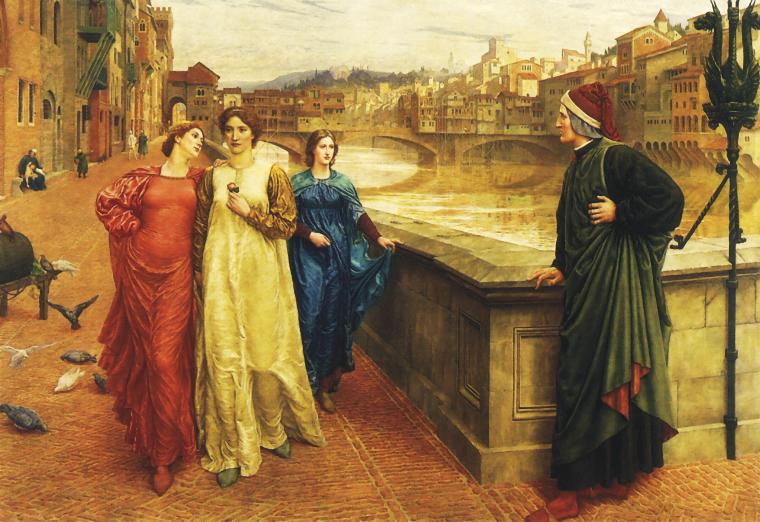
Dante and beatrice by Henry Holiday
Henry Holiday (17 June 1839 – 15 April 1927) was an English historical genre and landscape painter, stained glass designer, illustrator and sculptor. He is considered to be a member of the Pre-Raphaelite school of art. Holiday also did some sculpture, in 1861 producing a piece called "Sleep" which attracted favourable critical interest.
In 1867, Holiday visited Italy for the first time and was inspired by the originality of the Renaissance artists he saw on display there. In 1871 he went to Ceylon as part of the " Eclipse Expedition". His astronomical drawings were subsequently published in the national press and attracted great interest.
In January 1874, Holiday was commissioned by Lewis Carroll to illustrate The Hunting of the Snark. He remained friends with the author throughout his life. Holiday had been a socialist throughout his life and, together with his wife Kate and daughter Winifred, supported the Suffragette movement. The family were close acquaintances of Emmeline Pankhurst and her daughter, and had organised local suffragette meetings in the Lake District.
Holiday died on 15 April 1927. Dante and Beatrice is a painting dated 1884 and is on display in the Walker Art Gallery in Liverpool, England. It is considered to be Holiday's most important painting. It is executed in oil on canvas, measuring 142.2 centimetres (56 in) by 203.2 centimetres (80 in) and was purchased by the gallery in 1884.
When he died, Holiday was described as "the last Pre-Raphaelite". Many of Dante Gabriel Rossetti's paintings, including Dante's Dream, had as their subject the Italian poet Dante Alighieri, and this interest is the likely inspiration for Holiday's painting.
It is based on Dante's autobiographical work La Vita Nuova which describes his love for Beatrice Portinari. Dante concealed his love by pretending to be attracted to other women. The painting depicts an incident when Beatrice, having heard gossip relating to this, refuses to speak to him. The event is shown as Beatrice and two other women walk past the Santa Trinità Bridge in Florence. Beatrice wears a white dress and walks beside her friend Monna Vanna, with Beatrice's maidservant slightly behind.
In 1860 Holiday had painted another scene from La Vita Nuova which showed a meeting between Dante and Beatrice when they were children in the garden of Beatrice's father, and in 1875 he painted a portrait of Dante. In addition to the completed painting of Dante and Beatrice, the Walker Art Gallery owns three sketches he made for it. Two of these depict all the figures, while the third is of Dante alone. Holiday had also made nude plaster statuettes of the two main female figures to which he later added clothing. These are also owned by the gallery. The model for Beatrice was Eleanor Butcher, Milly Hughes modelled for Monna Vanna, and the model for the maidservant was Kitty Lushington.
Holliday was anxious that the painting should be historically accurate and in 1881 travelled to Florence to carry out research. He discovered that in the 13th century the Lungarno, the street on the north side of the River Arno between the Ponte Vecchio (seen in the background) and the Ponte Santa Trinita, was paved with bricks and that there were shops in the area; these are shown in the painting. He also learnt that the Ponte Vecchio had been destroyed in a flood in 1235. It was being rebuilt between 1285 and 1290 and in the painting it is shown covered in scaffolding.
Crossing the Brook by William (Mallord William) Turner

This painting is the culmination of Turner’s studies of Devon, which he visited in 1811 and 1813. His watercolours and drawings of the area were remarkably fresh and informal. Here, however, he creates a more monumental and self-consciously artful image in the mould of the seventeenth-century classical landscape painter, Claude Lorrain. Even so, contemporaries recognized that the scene was intended to show a particular place: the Tamar valley. This painting was exhibited in the year of the battle of Waterloo. It would have been hard to avoid the patriotic subtext of such a grandly ambitious depiction of the national landscape
Joseph Mallord William "J. M. W." Turner, RA
(baptised 14 May 1775[a] – 19 December 1851) was a British Romantic landscape
painter, water-colourist, and printmaker. Turner was considered a controversial
figure in his day, but is now regarded as the artist who elevated landscape
painting to an eminence rivalling history painting.
Although renowned for
his oil paintings, Turner is also one of the greatest masters of British
watercolour landscape painting. He is commonly known as "the painter of
light" and his work is regarded as a Romantic preface to Impressionism.

Joseph Mallord William Turner (above) was baptised on 14 May 1775,
but his date of birth is unknown. It is generally believed he was born between
late April and early May. Turner himself claimed he was born on 23 April, but
there is no proof of this.[a] He was born in Maiden Lane, Covent Garden,
London, England.
His father, William Turner (1745–21 September 1829), was a
barber and wig maker, His mother, Mary Marshall, came from a family of
butchers. A younger sister, Mary Ann, was born in September 1778 but died aged
four in August 1783.
Drawing of St John's
Church, Margate by Turner from around 1786, when he would have been 11 or 12
years old. The ambitious but unsure drawing shows an early struggle with
perspective, which can be contrasted with his later work
A View of the Archbishop's Palace, Lambeth – this
watercolour was Turner's first to be accepted for the Royal Academy's annual
exhibition in April 1790, the month he turned fifteen. The image is a technical
presentation of Turner's strong grasp of the elements of perspective with
several buildings at sharp angles to each other, demonstrating Turner's
thorough mastery of Thomas Malton's topographical style.
In 1785, as a result of a "fit of illness" in the
family the young Turner was sent to stay with his maternal uncle, Joseph
Mallord William Marshall, in Brentford, then a small town on the banks of the
River Thames west of London. From this period, the earliest known artistic
exercise by Turner is found, a series of simple colourings of engraved plates
from Henry Boswell's Picturesque View of the Antiquities of England and Wales.
Around 1786, Turner
was sent to Margate on the north-east Kent coast. Here he produced a series of
drawings of the town and surrounding area foreshadowing his later work. Turner
returned to Margate many times in later life.
By this time,
Turner's drawings were being exhibited in his father's shop window and sold for
a few shillings. His father boasted to the artist Thomas Stothard that:
"My son, sir, is going to be a painter". In 1789 Turner again stayed
with his uncle, who had retired to Sunningwell in Oxford. A whole sketchbook of
work from this time in Oxford survives, as well as a watercolour of Oxford. The
use of pencil sketches on location as a basis for later finished paintings
formed the basis of Turner's essential working style for his whole career.
Many early sketches
by Turner were architectural studies and/or exercises in perspective and it is
known that as a young man he worked for several architects including Thomas
Hardwick (junior), James Wyatt and Joseph Bonomi the Elder.
By the end of 1789 he
had also begun to study under the topographical draughtsman Thomas Malton, whom
Turner would later call "My real master". He entered the Royal
Academy of Art schools in 1789, when he was 14 years old, and was accepted into
the academy a year later. Sir Joshua Reynolds, president of the Royal Academy,
chaired the panel that admitted him. At first Turner showed a keen interest in
architecture but was advised to continue painting by the architect Thomas
Hardwick. His first watercolour painting A View of the Archbishop's Palace,
Lambeth was accepted for the Royal Academy summer exhibition of 1790 when
Turner was 15.
As a probationer in
the academy, he was taught drawing from plaster casts of antique sculptures and
his name appears in the registry of the academy over a hundred times from July
1790 to October 1793. In June 1792 he was admitted to the life class to learn
to draw the human body from nude models.
Turner exhibited
watercolours each year at the academy – travelling in the summer and painting
in the winter. He travelled widely throughout Britain, particularly to Wales,
and produced a wide range of sketches for working up into studies and
watercolours. These particularly focused on architectural work, which utilised
his skills as a draughtsman.
In 1793, he showed a
watercolour titled The Rising Squall – Hot Wells from St Vincent's Rock Bristol
(now lost) that foreshadowed his later climatic effects.
Cunningham in his
obituary of Turner wrote that it was: "recognised by the wiser few as a
nobel attempt at lift in landscape art out of the tame insipidities...[and]
evinced for the fist time that mastery of effect for which he is now justly
celebrated."
Turner exhibited his
first oil painting at the academy in 1796, Fishermen at Sea: a nocturnal
moonlit scene off The Needles, Isle of Wight. The image of boats in peril
contrasts the cold light of the moon with the firelight glow of the fishermen's
lantern.
Wilton said that the
image: "Is a summary of all that had been said about the sea by the
artists of the eighteenth century." and shows strong influence by artists
such as Horace Vernet, Philip James de Loutherbourg, Peter Monamy and Francis
Swaine, who was admired for his moonlight marine paintings. This particular
painting cannot be said to show any influence of Willem van de Velde the
Younger, as not a single nocturnal scene is known by that painter. Some later
work, however, as shown below, was created to rival or complement the manner of
the Dutch artist. The image was praised by contemporary critics and founded
Turner's reputation, both as an oil painter and as a painter of maritime
scenes.
Turner travelled widely in Europe, starting with France and
Switzerland in 1802 and studying in The Louvre in Paris in the same year. He
made many visits to Venice. On a visit to Lyme Regis, in Dorset he painted a
stormy scene (now in the Cincinnati Art Museum).
Important support for
his work came from Walter Ramsden Fawkes, of Farnley Hall, near Otley in
Yorkshire, who became a close friend of the artist. Turner first visited Otley
in 1797, aged 22, when commissioned to paint watercolours of the area. He was
so attracted to Otley and the surrounding area that he returned to it
throughout his career. The stormy backdrop of Hannibal Crossing The Alps is reputed
to have been inspired by a storm over the Chevin in Otley while he was staying
at Farnley Hall.
Turner was a frequent
guest of George O'Brien Wyndham, 3rd Earl of Egremont at Petworth House in West
Sussex and painted scenes that Egremont funded taken from the grounds of the
house and of the Sussex countryside, including a view of the Chichester Canal.
Petworth House still displays a number of paintings.
As Turner grew older,
he became more eccentric. He had few close friends except for his father, who
lived with him for 30 years and worked as his studio assistant. His father's
death in 1829 had a profound effect, and thereafter he was subject to bouts of
depression. He never married but had a relationship with an older widow, Sarah
Danby. He is believed to have been the father of her two daughters born in 1801
and 1811.
Turner died in the house of his mistress Sophia Caroline
Booth in Cheyne Walk, Chelsea on 19 December 1851. He is said to have uttered
the last words "The sun is God" before expiring. At his request he
was buried in St Paul's Cathedral, where he lies next to Sir Joshua Reynolds.
His last exhibition at the Royal Academy was in 1850.
Turner's friend,
architect Philip Hardwick (1792–1870), son of his tutor, Thomas Hardwick, was
in charge of making the funeral arrangements and wrote to those who knew Turner
to tell them at the time of his death that, "I must inform you, we have lost
him." Other executors were his cousin and chief mourner at the funeral,
Henry Harpur IV (benefactor of Westminster – now Chelsea & Westminster –
Hospital), Revd. Henry Scott Trimmer, George Jones RA and Charles Turner ARA.


Subscribe to:
Posts (Atom)